Take the Genetic Height Predictor Test!

Here are 3 quick methods you can do to find out if your height measured up to what it ‘should’ be or determine how tall your child will be.

Methods for Predicting Your Child’s Height

  1. Genetic Potential Height: Add the height of your mother and father together in inches and find the average height. Then add 2.5 inches to determine a boy’s height and subtract 2.5 inches to determine a girl’s height.Kids height predictors
  2. Two Times Two: Figure out how tall your child is or was when she/he was two years old, then multiply that height by two.
  3. Follow the curve: Measure your child’s current height, then plot it on the growth curve chart used by pediatricians. Follow along on their growth curve—staying in the same percentile and see where they end up as an adult.”- verywellfamily.com

None of these methods are absolute, as other growth factors influence how tall you will be, such as posture issues and scoliosis.

Some say that the ratio of your height is 1:1 to your arm length or wingspan.

Wingspan is your arm length measured from the middle finger of your right hand to the middle finger of your left hand when outstretched.

Measuring wingspan is just one of the many measurement tools that I take when you are a patient here, specifically for posture related issues, such as scoliosis, Schueremann’s, kyphosis or hyperlordosis.

There is also research linking arm length or wingspan to excelling in athletic sports, specifically those that involve balls, wrestling and the mixed martial arts.

Makes sense when you think about it since the longer your arm is, then you can reach your opponent or the ball before those with shorter limbs!

Study shows wingspan has a correlation to athletic prowess in the NBA, MMA

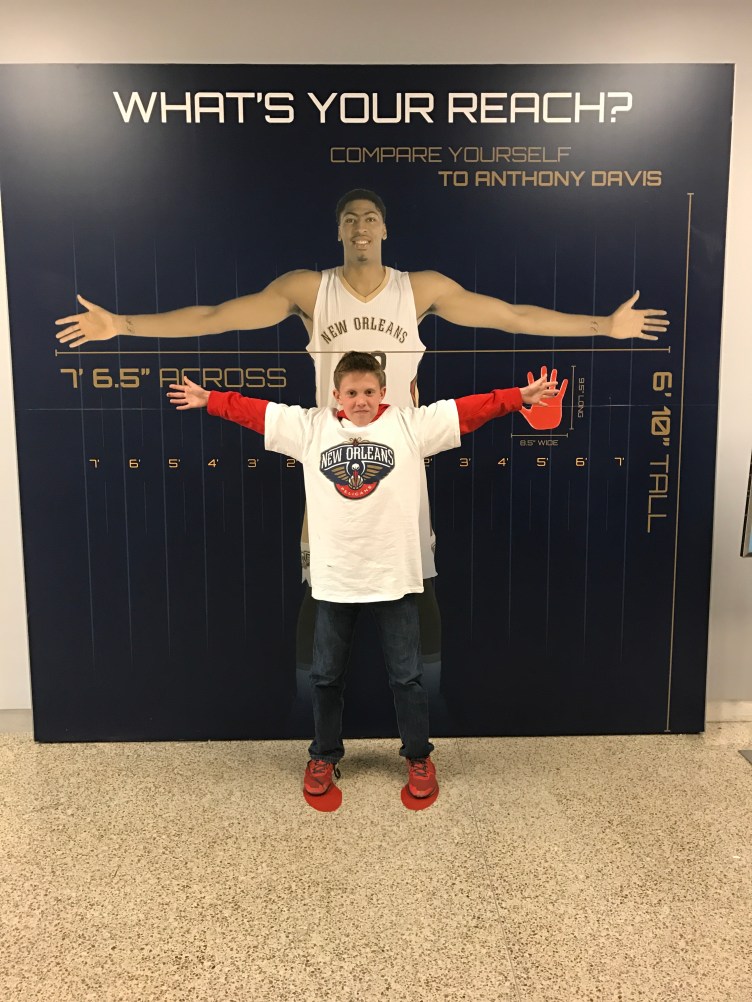
The words What's Your Reach? with NBA player Anthony Davis spreading his arms out wide and child standing in frontCurious?

Come in for a posture assessment and see how wingspan reflects your height!

Book your appointment

“No one can really predict to what heights you might soar. Even you will not know until you spread your wings.” – Gil Atkinson

Types of Scoliosis Bracing

What type of Scoliosis Brace do I need?


The answer: YES!

If you or your child has been told to wear a full-time, solid brace due to scoliosis, then it is wise to do your homework and read up on what types of braces are out there for you.

Note: I do not sell, make or distribute any braces, and I do not get any payment or bonuses for promoting one type over another.

The ideal scoliosis brace should allow your body to ‘breathe’ by having openings cut out in the brace where your ribs need to expand. Scoliosis is a 3-dimesional curvature so simply tightening a brace with straps is not the answer, as that will only SQUEEZE you in 2-dimensionally and not fully correct the curvature.

Schroth therapy can complement any scoliosis brace but not every brace can complement Schroth therapy.

Braces have evolved over the years and here is a snapshot of their history:

  1. Milwaukee Brace: original scoliosis brace invented in 1946
    Cervico-Thoraco-Lumbo-Sacral Orthosis (CTLSO)
    • Pros: good for high scoliosis curves in cervical and thoracic spine• Cons: metal, not 3-dimesional and old-fashionedoriginal scoliosis brace invented in 1946
  2. Providence or Charleston Nighttime Brace: developed in the 1990’s
    • Pros: It is used for nighttime and part-time only.
    • Cons: It doesn’t allow for walking  due to it being low over the hips; only good for balanced and single curves
     Providence nocturnal scoliosis orthosis.
    Thoraco-Lumbo-Sacral-Orthosis (TLSO); developed in 1972
  3. Boston Brace: Thoraco-Lumbo-Sacral-Orthosis (TLSO); developed in 1972
    • Pros: Most common choice by doctors due to familiarity and gets good results. Extensive research
    • Cons: Heavy. Straps fasten in the back making it hard to take on and off by yourself. It doesn’t correct the curve in a 3 dimensional pattern and often semi- custom or pre-fabricated. Even when these braces are individually designed, they are little more than modified “barrel” braces. Can give too much abdominal pressure. Made by traditional casting.
    Full time scoliosis orthosis.
    Boston Brace: Thoraco-Lumbo-Sacral-Orthosis (TLSO); developed in 1972
  4. WCR Brace (Wood-Cheneau-Rigo): modern brace developed by Dr. Rigo, Grant Wood and Chêneau to de-rotate the spine and used in conjunction with the BSPTS/Schroth Method
    • Pros: Custom made and computer-generated to fit exactly to your curve type. Thin and allows for expansion in the rib cage where needed and lightweight ; comes in lots of patterns. It is an international brace as it is made in the US AND in Spain.
    • Cons: Big and long  as the brace comes up and under the armpit. Can be costly.
    modern brace developed by Dr. Rigo

Still not convinced? Check out these x-ray results:

x-ray comparision

(Photo from Align Clinic website)

Here is their website if you would like more information, case studies, results or questions answered. The Align Clinic. They are located in Green Bay, WI, San Mateo, CA, Houston, TX and I host a clinic as needed here in Tallahassee.

Regardless of which brace you choose, none of them will work if you don’t wear them! So please wear your brace 18-20 hours a day as recommended to get the best results. It’s very similar to wearing orthodontic braces in your mouth or a retainer: if you don’t wear it – it won’t work!

See you at the next bracing clinic!

Our next Scoliosis Bracing clinic will be

January 2020
WCR Evaluation and Fitting clinic

Suite 114, 1809 Miccosukee Commons Dr, Tallahassee, FL 32308, USA

Presented by Walter Ramos, LO of Align Clinic

Hosted by Joy Smith, Schroth PT at Joy of Therapy Physical Therapy Clinic

Phone: 920-940-5277

This special Cheneau Rigo Brace evaluation is a complimentary opportunity for all patients and families who may have questions or concerns regarding the fit, function, or design of their brace. This clinic is also open to BSPTS, Schroth PTs, MDs, and any new patients that may want to learn more about the Cheneau Rigo brace.

To schedule your complimentary evaluation, please call Lynn at 920-940-5277.

We urge you to take advantage of this unique opportunity and we look forward to seeing you soon! Appointments are limited and filling up fast; therefore it will be booked as “first come, first served.”

A Scoliosis Exercise & Bracing Success Story


“Here’s proof why managing a scoliosis curve during a child’s growth spurt is so important” 

It’s overdue to share with you a scoliosis success story that I would love to take all of the credit for, but this one really goes to my patient and her family.

This sweet 12year old girl came to the Joy of Therapy in April 2019 with some back pain, an ever increasing scoliosis curve,  and discomfort wearing a back brace. Plus, little did we both know, but she was about to hit a growth spurt over the summer. 

Fast forward 5 months, and nearly 20 treatments later, she has decreased her scoliotic curve by 50%!

She went from wearing a rigid brace and no therapy with a 48 degree curve in the thoracic spine and 43 degree curve in the lumbar spine, to a 22 degree curve in the thoracic spine and 20 degree curve in the lumbar spine while wearing a dynamic brace and therapy.

Plus she grew 2 inches during that same time! 

How did she do it?

Through the combined effort of:

  1. Specific Scoliosis Exercises custom designed for her curve type by Joy Smith,PT 
  2. An amazing dynamic WCR brace from the Align Clinic which she wears consistently 20+ hours a day designed by Walter Ramos,L/O,CPO Align clinic
  3. Supportive and loving family
  4. Great medical care by Dr. Ryan Price at Tallahassee Orthopedic Clinic TOC

The key to all of this success hinges on the fact that she wanted to make this change and stuck with the program.

She attends therapy regularly, wears her brace as prescribed and her dad has even made the Schroth bars for her to use at home.

So what does this mean for you if you have scoliosis? No matter how big or small your curve is, if you are a child, teenager or adult or whether or not you have a brace or don’t want to wear a brace- a comprehensive program that addresses ALL of your needs is here for you.

Contact me today to find out how to start feeling stronger, straighter and feel better all over today! #scoliosis #schrothmethod #physicaltherapy #cureais #posture #curvygirls

Call or email here

Is this poor posture or something more?

Physical picture vs x-ray of structural kyphosis


This is Scheuermann’s  Hyperkyphosis

It is a “structural kyphosis that typically develops during adolescence, causing the kyphotic spine to become rigid, and sometimes progresses into adulthood.” — Scoliosis Research Society.

It is not poor posture or a lazy posture. This is a  condition that includes physiological changes to the structure of the thoracic spine, therefore causing an increased rounding of the trunk.

The Schroth Method can help those diagnosed with Scheuermann’s by elongating and de-rotating the spine. Schroth exercises are customized for your unique spinal deformation. The method teaches you how to:

  • Correct spinal rotation and increase lung capacity with a rotational breathing technique.
  • Help restore normal spinal position with pelvic corrections, breathing technique, and stabilizing isometric contractions.
  • Improve your posture during routine daily living, not just during therapy.

Scheuermann’s disease begins before puberty. It is not known what triggers the abnormal growth, but there are theories that the bone may have been injured at some point, or that the area was weak before puberty. Heredity is thought to play a role, but the connection is not straightforward.

The condition is connected to skeletal growth, and the curvature does not usually increase after growth is completed. It is estimated that 1 to 8 percent of people develop the condition.

If you or anyone you know has this condition, please go to your doctor and ask for a referral to physical therapy. Then call and schedule your appointment today with Joy Smith,PT the  ONLY physical therapy specialist in the Florida Panhandle to treat Schuermann’s disease according to the Schroth Method.

#posture #physicaltherapy #schrothmethod # back pain

Schedule your evaluation today

Do adolescents really grow more in the summer?

Get to Know more about Your Kid’s Growth Spurts

Everything you need to know about your kid's growth spurts flyer

6 Signs Your Kid Is Having A Growth Spurt

Could it be the warm summer months, lots of sunshine, less stress and more sleep that causes seemingly ‘more growth’ in the summer for adolescents? Perhaps. But whatever the reason may be, your pre-teen or teen is making big gains in his/her body.

And summer is a great time for annual doctor check-ups and sports physicals. Plus keep an eye on their spines when they don a swimsuit. Do you notice a hump in their ribs when they bend over or does one of their shoulder blades look like it is ‘winging out’? If so, definitely follow up with your pediatrician for a scoliosis screening. It is always best to catch the curve while it is small so that the best care can be given. But whatever you do , don’t ‘wait and see’ if the curve in their spine will straighten out on its own. There are several conservative treatment options available to your adolescent to monitor, halt and/or reverse the scoliotic curve: no matter how small or big!

Inquire below for more information about conservative scoliosis treatment options :

Contact us today!

Want to know a way to decrease inflammation naturally and holistically WITHOUT the use of medications?


fruit cherries
Photo by Lisa Fotios on Pexels.com

Cherries! Or more specifically, Tart Cherry Juice.

All it takes is simply 2 tablespoons of tart cherry juice FROM concentrate, preferably before bedtime ( I’ll explain the ‘why’ for that in another post) and you will see and feel the difference this delicious fruit can make in your body.

The following are excerpts from the insightful book, ‘Taming Pain: Lessons from the Trenches” by Cheryl Wardlaw.Get the book here

“Research shows that cherries reduce inflammatory chemicals by as much as 25% (after only 28 days of eating them)  without having a negative effect on blood sugar or insulin levels.  Even better, these gains are sustained for over a month after you stop eating cherries (although why would you stop eating cherries?!) Cherries are packed with antioxidants and anti-inflammatory substances, including anthocyanin, quercetin and melatonin, and assist the body in producing glutathione (the main anti-inflammatory for the brain.)”

Anyone who has gout will most likely tell you that they already know the benefits of drinking tart cherry juice as it helps to decrease gout symptoms. That is because the anthocyanin in cherries reduces blood urate levels by 15% in as little as 3 days. Turns out that “cherries have the HIGHEST levels of anthocyanin of any food (blueberries don’t have any) and specifically block COX I and II (inflammatory chemicals., just like arthritis medication. Anthocyanins are more effective than vitamin C or E and AS EFFECTIVE as Naproxen, Ibuprofen or Aspirin WITH NO BAD EFFECT ON YOUR STOMACH! Note: for kidney health you should not take over 5000 NSAIDs and 1000 acetaminophen tablets in your lifetime!”

To sum it up here’s what anthocyanin does for you:

“Lowers urate (uric acid) levels in the blood stream to control gout

Acts an anti-inflammatory on par with NSAIDs

Suppresses production of pro-inflammatory cytokines

Suppresses growth factors 

Protects cell membranes”

In my next blog, I will talk about more AMAZING things that cherries can do for your health.

Cherry season is nearly here, so plan on indulging in them!

And in the meantime, go buy some Tart Cherry Juice FROM CONCENTRATE, pour 2 tablespoons into a cup and cheers!

(Caution: cherry juice is a natural blood thinner. If you take prescription blood thinners, then please talk to your doctor about your medications if they need to be adjusted)

Breaking news! An update on Melissa’s story: ” I won’t wait and see anymore”

Update on Melissa’s Story

Melissa and her daughterIn February, I posted a story about my sister, and her journey with scoliosis. (If you haven’t had a chance to read it, then click here to catch up before you read about her progress)  Melissa’s story

Melissa went to her annual check-up this past month and got some encouraging news! Last April, prior to beginning her Schroth therapy in the Fall, She went to her annual physical exam and was saddened to learn that she had ‘shrunk’ nearly 2 inches! She had been 5’8″ since she hit maturity as an adolescent, and when she learned she had lost nearly 2 inches in height:  it was not good news (especially since that meant she would now be the same height as her older and shorter sister!)

But all kidding aside, she knew that this change in height really meat that her scoliosis may be getting worse.

Fast forward 6 months and she began the Schroth physical therapy at the Paley Institute in West Palm Beach, FL alongside with her youngest daughter, who also has scoliosis.

They both went to many treatment sessions and enjoyed it so much that they had Schroth wall bars built and installed in their home for them to use on a daily basis. They also have the placement pads and do the exercises as recommended by their physical therapist.

This past month Melissa went again to her annual physical exam and her doctor measured her height. Guess what? She is now back to her usual 5’8″! She was so excited that she immediately called to tell me her good news. She attributes the positive change to doing the prescribed specific scoliosis exercises (PSSE) and learning her curve.

And as if that wasn’t enough good news: there’s more! Her daughter, went in for a DIERS scan and it found that her curve decreased 7 degrees! The DIERS Formetric 4D is a light-optical scanning method which projects a line grid on the back of the patient which is recorded by an imaging unit.

So what’s the ‘take away’ message here? Schroth Therapy works for improving posture and decreasing scoliotic curves! But it only works if you put the effort into it. Both Melissa and her daughter are motivated for change !

If this story speaks to you or someone that you know who may need to hear this, then please contact me to find out how I can help improve your scoliotic posture.

“Nothing motivates you like movement. If you need motivation, get moving.”  –Christy Wright

Contact me today!

← Back

Thank you for your response. ✨

Warning
Warning
Warning

Warning.

I bet you’d never guess that the nagging pain in your hip could be coming from somewhere else…

Do you have hip pain or pain in your thigh that just won’t go away?

(Now if you do have hip degeneration and have been told you need a hip replacement, then you probably have more going on than this article pertains to)

Ever thought that there may not be anything wrong at all with your hip? It may in fact be  ‘referred pain.’

What is referred pain? It is pain in an area of your body that can often be some distance away from the actual stressed tissue.

One good example is sometimes hip pain can be diagnosed as hip bursitis: inflammation of the bursa (fluid-filled sac near a joint) at the part of the hip called the greater trochanter. When this bursa becomes irritated or inflamed, it causes pain in the hip. Yes, hip pain truly can be coming from your hip, but when you have tried to get rid of it with traditional therapies or injections and it still is there,  then the source may be coming from somewhere else…and it may be nerve root referred pain. 

Check out this map of the dermatomes of the body that depicts where nerve roots refer to: 

Mapping the Spinal Cord Color Chart

The following excerpt is from ‘Taming Pain: Lessons from the Trenches.”- Second Edition 2013 by Cheryl F. Wardlaw, PT MMSc, CFMT :

“A nerve root is the part of the nerve that comes off of the spinal cord and goes out the hole between two vertebrae.

Each nerve root has some fibers mixed in from the nerve root above and below, so it’s not EXACT. Each nerve root, when stressed, can cause pain in a predictable path. It will cause weakness in predictable muscles. Let’s take the L4 nerve root for example. Let’s say you have pain on the side of your hip and in the front of your thigh. The muscles that pick up your big toe (L4) and straighten your knee (L3& L4) are weak. I would sure need to look at what could be irritating the L4 nerve root!

Could it just be hip bursitis? Doubtful. Hip bursitis doesn’t make your big toe weak. Could it be 5 things: hip bursitis, a pulled muscle in your thigh, some knee arthritis, a bunion on your big toe and low magnesium? Well, it could be, but I would still have to rule out the L4.

Things that stress a nerve root:

If we decide that a nerve root is squawking, and we know which nerve root, the question still remains, what is irritating the nerve root? So here goes:

The Facet joint: the joints in your spine are called facet joints

The Nerve Root: comes out of the hole in front of the facet joints. Changes at the facet joint can decrease the size of the space and put pressure on the nerve. Inflammation will be the result.

The Disc: The spacer between the vertebrae is the disc. If the disc shrinks down (degeneration) the bones will get closer together. The size of the opening will decrease and the nerve will be compressed and will inflame. If the disc bulges back, the same thing happens.

The Spinal Canal: The space that the spinal cord runs through is called the canal. Across time, bone can build up inside the canal and make less room for the nerve root. This condition is known as spinal stenosis. The nerve will be compressed and will inflame.

Now that we know where it is, ( Let’s stick with L4 as our suspect), what might be causing it ( let’s choose a locked facet) and that the nerve root is inflamed, our job is as simple as a game of CLUE : Colonel Mustard, in the library, with the candlestick! Referred pain patterns help me figure out where I should be working!

If your therapist or doctor are only treating your symptoms, and not searching very actively for where the pain is coming from, then you will be hurting a very long time.”

See how maybe your hip pain isn’t really coming from the hip itself, but rather may be coming from your back? Contact me today to see how I can help solve your pain puzzle and get rid of the nerve culprit! 

← Back

Thank you for your response. ✨

Warning
Warning
Warning

Warning.


High Hopes Realized for Female Entrepreneur!

Joy Smith standing next to her logo in her clinic

‘High Hopes’ Realized

I love Panic! At the Disco’s song, ‘High Hopes’, as I have dubbed it my ‘theme song’ these past several months while I plugged along creating my physical therapy clinic:

“I had to have high high hopes for a living. Didn’t know how but I always had a feeling.”  (Check out their video if you want to get that song in your head all.day.long. )  Panic! At the Disco- High Hopes

Many years of building a community of clients and contemplating just how to do this thing called a business, finally culminated into a fabulous celebration last night. The  open house to my brand new PT clinic, Joy of Therapy, was a smashing success!

 I truly enjoyed every minute of it and am so very grateful for the many clients, friends and family that took time out of their day to come and support my “dream come true!” (We were all having such a good time, that we forgot to take pics of everyone that came to the open house. Oops! But check out the good ones below.)

The food was DELICIOUS (thank you to Brandy L.,  Sarah H. , Tasty Pastry, Publix and Josey V. ) , the decor GORGEOUS ( thank you to the talented, Karyn Tarmey), set- up and serve went SMOOTHLY (thank you to my mom and dad, Brandy and Kylie L.) and hey, I looked pretty good too! (thanks to my stylists, Jillian Visconti (hair stylist) and Marianne Brooks with Cabi). It takes a village to pull this off, and my heart is filled with gratitude for all of you.

The clinic is truly reflective of ‘me’ and how I believe that physical therapy should and needs to be delivered: efficient, thoughtful, caring, valuable to you, your time and your money and most of all, joyful.

So if you haven’t already come in for your evaluation, then what are you waiting for ?! I am here and ready to serve your PT needs whenever they may arise for you. Here I come Tallahassee!

Melissa’s story: “I won’t ‘wait and see’ anymore”

Melissa’s Story

Melissa smilingMelissa’s story probably began like most of yours. She was a healthy child who stayed active in extracurricular activities and enjoyed just being a kid. Then, during adolescence in middle school, she was given a surprising diagnosis: she had scoliosis. How she dealt with it as she grew into adulthood and finally found answers, strength and relief through the use of Schroth physical therapy is truly inspiring.(Spoiler alert: she’s my sister)

I am a 42 year old, health-conscious woman married to a loving husband with two amazing daughters, whom I enjoy homeschooling. I have a good life and try to live every moment to its fullest. But what most people may be surprised to hear is that for 20 years I have lived with daily, achy and often sharp pain in my back due to scoliosis that was diagnosed when I was a teenager. I exercise daily, which can include Pilates, walking and strength training. Thankfully, I have been able to avoid taking prescription pain pills. But some days are really hard to get through due to pain.

I have silently struggled with my pain and diagnosis as best I could, and it hit me hard a couple of years ago, when my youngest daughter was also diagnosed with scoliosis. It was then that I had had enough and wanted real solutions since I didn’t want her story to be like mine. 

When I  was diagnosed with scoliosis during a middle school health screening, I had no  pain or symptoms. No one in my family had scoliosis, so no one was looking for it. It was recommended to my parents that I see a chiropractor to help. He adjusted me, and my clearest memory of that experience was leaving there crying in tears due to the pain of the adjustment. It hurt so bad! (FYI: I now know that no one with scoliosis should be manipulated since the vertebral bodies of the spine grow irregular). I was told by my doctor to ‘wait and see’ how the curve would progress.

I went on to high school and college with no pain or limitations, and yet unbeknownst to me, my curve was only getting worse. By the age of 22, I was working in hotel management, and my job required me to be on my feet all day long. I loved that job, but oh the pain in my back had set in, and it hurt! So off I went with my parents for x-rays at Miami Children’s Hosptial and to see the best doctor at the time for scoliosis. He said that I now had an ‘S’ curve that was 40 degrees and surgery was not recommended, unless I wanted it for cosmetic reasons. Once again I was told to ‘wait and see’ and hope that my rib cage wouldn’t puncture a lung! I did try traditional physical therapy with minimal relief.

When I was in my 30’s, after I had given birth to my beautiful daughters, I went in again for x-rays since the pain was only getting worse. This time the curve had progressed to 48 degrees and now borderline for surgery. Guess what? I was told to ‘wait and see’.

So when my youngest daughter got the  diagnosis of scoliosis, I wasn’t going to ‘wait and see’ anymore. As a toddler, I intuitively knew that something wasn’t quite right with the way she walked. I took her to a pediatric orthopedic doctor, a podiatrist and countless visits to the pediatrician to try and figure out what was going on with her legs and feet. No one suspected scoliosis, not even me.

By the time she was 5, she was in special shoes with a lift and running was sometimes awkward. My sister, who is a physical therapist, looked at her and noticed that one hip was higher than the other and tried manual therapy which helped a little. She looked again months later ( since she doesn’t live near us) and noticed the same thing and a slight curve in her back. She recommended I go to an orthopedic doctor for evaluation. There she was diagnosed with mild scoliosis of 10 degrees, and you can imagine what words I heard next:  ‘wait and see.’

This time, I wasn’t going to tolerate that phrase and immediately called my sister for her professional opinion. This was a defining moment in our conversation: she told me there was help with the Schroth Method. It is a unique 3-dimensional treatment approach that helps to elongate, de-rotate and strengthen the scoliotic spine. It aims to halt or even reverse the progression of the spinal curve. What a relief to hear those new words!

By this time, my sister had researched the Schroth Method and was training to be a certified physical therapist with this specialty. I too researched this myself and discovered that it is an intense certification and to only go to those who have this training and understanding of the scoliotic spine . She was able to connect me with the Paley Institute where I met Dr. Feldman. For the first time in my life I was not told to wait and see!’ He agreed that the Schroth Method works and referred me to Lisa Ritze, PT, a certified Schroth-Barcelona physical therapist.  She and other trained PT’s in this method have been working with both myself and my daughter since October 2018. We are very compliant with keeping up with the exercises and therapy.

It’s so important to always go to therapy for tune-ups since scoliosis tricks you into thinking that your spine is straight when it is so not! Plus you need to continue through puberty since growth spurts bring on big changes in the spine.

Over these past several months, physical therapy with the Schroth Method has changed mine and my daughter’s lives dramatically. I now have better tools to manage my back pain, and I am so glad that my daughter’s spine won’t have the opportunity to get to where my spine did. My daughter performs her daily exercises at home now and she knows the tools to help her back when she has pain or needs lengthening. It has also given her new and improved strength that she uses on the swim team! She said to me the other day, this therapy makes me stronger, gives me space in between my ribs and makes my back feel so good!”

My x-rays last year showed an upper curve of 53 degrees and a lower curve of 51 degrees. I still do not want surgery and my new, well-informed doctor, is confident that I won’t need surgery either. I know that at my age I won’t be able to make big changes in the curve, but I can stop the progression and avoid early arthritis by doing the Schroth Method exercises .

I am so grateful for the conservative treatment of scoliosis through the Schroth Method! I would have given anything to know about this method back in the 1990’s, but I know now and will never look back. I am also thankful for the time, advice, dedication, passion, love and God-given talent that my sister has as a physical therapist.

Oh, and did I mention that her name is Joy Smith, PT?! Yep, she’s the one you need to go and see right now if you have scoliosis! I wish she lived closer so I could come to her new clinic as often as I wanted to do this therapy with her.

I am here to tell you with full confidence that this method works and to not waste another day in pain!

More importantly, don’t let your child with scoliosis become a ‘wait and see’ adult in pain.

Run, don’t walk, to get your Schroth physical therapy evaluation today to see how it can make a difference in your life! –Melissa